Apofruit announces its future strategies and presents 12 new projects
Apofruit announces its future strategies and presents 12 new projects
- Information
The Apofruit Group has reviewed its future strategies, presenting projects under way and development plans affecting the entire organisation, from production to marketing.
The figures
The figures reflect the scale of a leading organisation in Italy’s fruit and vegetable sector. In 2025, Apofruit Italia recorded deliveries of 162.000 tonnes of fruit and vegetables and a turnover of 270 million euros. The cooperative has 12 processing plants and 11 facilities dedicated to receiving and storing produce, with production operations spread across several Italian regions. In terms of employment, it has 178 permanent employees and 1.736 seasonal workers.
At consolidated level, in 2025 the Group achieved a production value of 401 million euros, compared with 348 million in 2021, an increase of 15,2%. In the same period, payments to members rose from 127 to 148 million euros, an increase of 16,5%. Total investments made over the five-year period 2021-2025 amounted to 40 million euros.
Organic produce
Organic produce plays an important role in the commercial strategy, representing 25% of total volumes and 30% of Apofruit's turnover. In 2025, the Group marketed 56.500 tonnes of organic produce, with a total value of 141 million euros, up 8% on the approximately 130 million euros recorded the previous year. Around 500 member farms are active in this sector, with Canova, a Group company, at the heart of its commercial organisation and its presence in domestic and international markets.
“Organic produce represents a fundamental diversification of production and a strategic business. In a challenging context such as 2025, we managed to maintain and increase volumes thanks to the positioning of our brands, our work on innovative varieties and a well-established presence in the markets,” explained Managing Director Ernesto Fornari.
Projects
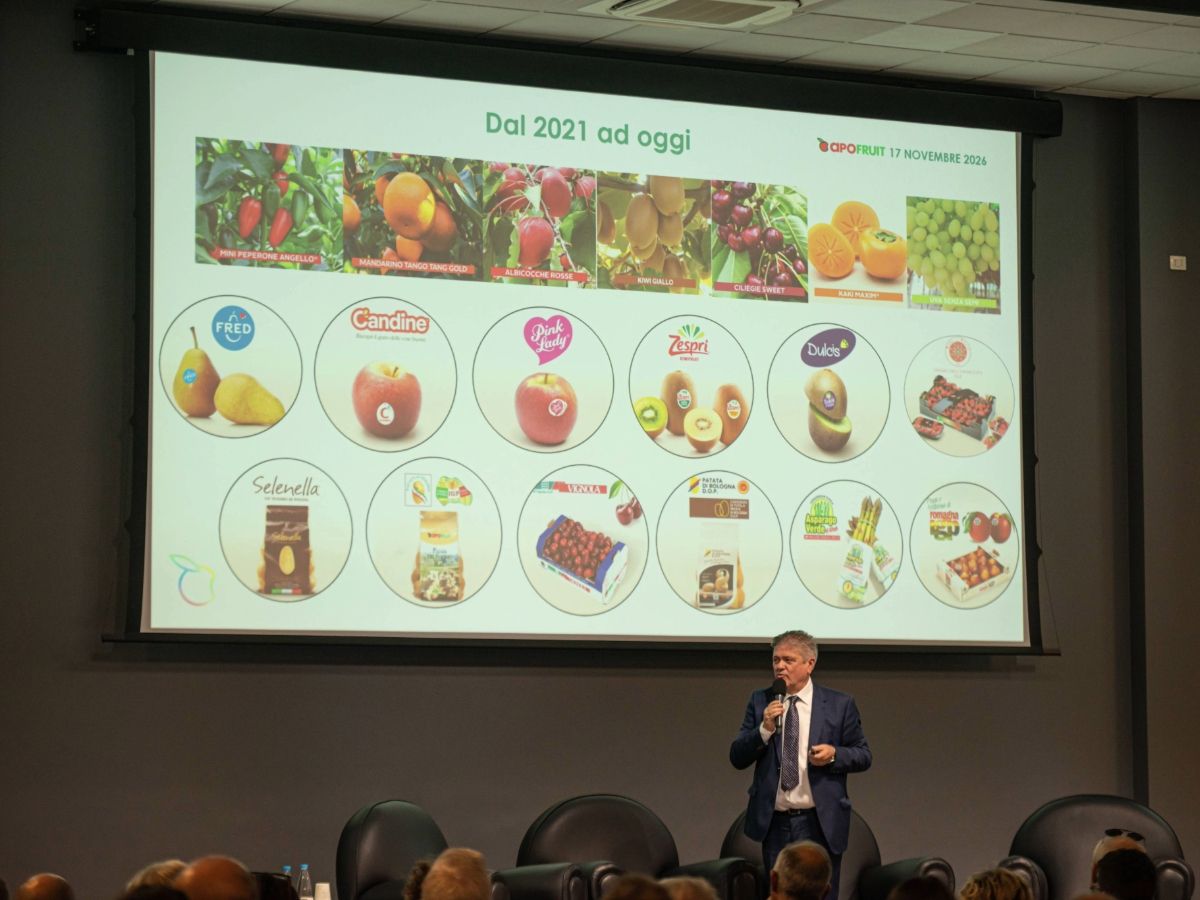
12 projects are supporting the Group's development, with initiatives spanning several areas of the supply chain. An important part concerns varietal innovation, through collaboration with leading research institutes and international breeders, and trials of new genetic material capable of meeting market demand, extending marketing calendars and offering producers greater income opportunities. The sectors concerned include peaches and nectarines, with programmes aimed at tolerance to brown rot and the search for resistance to sharka, and seedless table grapes, where work on different genetic materials also aims to ensure greater continuity of availability throughout the year. In the citrus sector, research focuses in particular on pigmentation and extending the harvest period, with new varieties such as the late-season Kinnow mandarin and the Onix orange. Development of Dulcis kiwi and other projects to enhance the value of produce are also continuing.
At the same time, the Group is accelerating its efforts on the technology and plant efficiency front. Investments include automated multi-product machines, weight-combination systems to improve productivity and recover excess weight, as well as smart machinery for grading and sorting products, with associated artificial intelligence models. Energy is another significant area. Apofruit currently has 14 photovoltaic systems in operation at its facilities. A further investment of approximately 1 million euros is also planned to install more than 800 kWp of new capacity at the Pievesestina, Longiano and Altedo facilities, with 275, 288 and 243 kWp respectively. The estimated self-consumption rate is around 95%
People
The innovation process also concerns the organisation and skills. The cooperative's strategy aims for growth that involves not only facilities and machinery, but above all people, who are considered fundamental to the company's development. The aim is to build an increasingly efficient organisation, capable of supporting producers through changes in the sector and making the most of opportunities offered by research, technology and new markets.
Among the cooperative's priorities is also generational renewal, an issue that directly affects the continuity of farming businesses and, in the longer term, the governance of the cooperative system itself. Data on the age profile of the membership highlight a concern: members under 40 account for 13% of the membership overall, while those aged over 50 account for 72,9% of the membership.
To address this issue, Apofruit has maintained a Young Farmers Group for over twenty years; it has now become a project with dedicated resources and a defined governance structure. It comprises around 30 young farmers under 40 from all the cooperative's production areas. The aim is not only to encourage discussion between the younger generations, but also to build a programme of training and participation that enables young people to learn more about how the cooperative operates, explore technical, financial and commercial matters, and gradually acquire skills and responsibilities. The project includes a steering committee made up of the young members themselves, a programme of activities throughout the year, and opportunities for meetings and training involving the different local groups.
This is an investment that also looks to the future composition of the governing bodies, creating a pool of new professionals and potential board members. “The Young Farmers Group is an asset in which we are investing heavily, because the issue of generational renewal is clear for all to see: the average age of Italian farms continues to rise, and it is not easy to keep young people in the sector. To do so, we must play an active part, working both on strategic projects capable of generating income and on involving and encouraging young people, listening to their needs and including them in the cooperative's various activities,” said President Mirco Zanotti.
This article was translated from the original version in Italian with the assistance of artificial intelligence. In case of discrepancies, please refer to the original version in Italian.